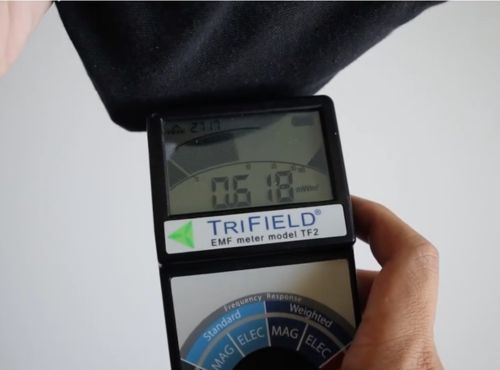
I’ve been using the Trifield TF2 as my primary home testing meter for years. It was the first meter I ever bought, and after testing a lot of other options since then, it’s still the one I reach for first when I’m walking through a room I haven’t measured before. That’s not a small endorsement.
This review is going to tell you exactly what the TF2 does well, where it falls short, and who it’s actually right for. Because it’s not the right meter for everyone, and I’d rather you know that upfront than spend money on something that doesn’t fit what you’re trying to do.
If you already know you want it, you can check the current price here. Otherwise, keep reading.
Affiliate disclosure: I bought this meter myself. If you purchase through my link I may earn a small commission at no extra cost to you.
What the Trifield TF2 Is
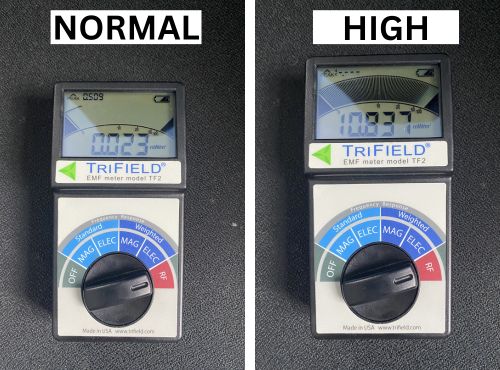
The Trifield TF2 is a three-in-one meter made by AlphaLab, a US-based scientific instrument manufacturer. It measures all three types of EMF you’re likely to encounter in a home: AC magnetic fields, AC electric fields, and RF radiation. That combination in a single handheld device, at this price point, is what made it the go-to recommendation for home testing and still does.
It runs on a standard 9V battery, comes with a soft carry case, and weighs just under a pound. The display is backlit and readable in dim rooms, and it updates quickly enough to catch fluctuations as you move through a space. There’s also an audible alert that beeps in proportion to the field strength, which is genuinely useful when you’re walking slowly through a room and want to keep your eyes off the display. You can follow the sound to the source.
The manufacturer is AlphaLab, the same company behind professional-grade gaussmeters used in research settings. The TF2 is their consumer-facing product, and you can feel that it was designed by people who understand measurement instruments rather than by a marketing team trying to capitalize on EMF anxiety.
What It Measures and How Well It Does It
The TF2 covers the three field types that matter most for home testing. Here’s how it performs on each one.
AC Magnetic Fields. This is where the TF2 genuinely excels. The magnetic field mode is 3-axis, meaning it takes simultaneous readings from three directions and gives you a combined result. You don’t have to rotate the meter to find the peak reading the way you do with single-axis meters. You just hold it steady and read the number. The range runs from 0.1 to 100 mG, which covers everything you’re realistically going to encounter in a home, from background levels in the 0.1 to 0.5 mG range up through appliance readings that can push well into elevated territory right at the source.
In my experience, the magnetic field readings on the TF2 are reliable and consistent. When I’ve compared the same spot to readings from other quality meters I own, the numbers are in the same range. That cross-referencing matters more than any spec sheet when it comes to trusting a consumer meter.
The stove photo below is a good example of what the magnetic field mode shows you in a real home. Right up against the stove I measured over 80 mG. A foot or two back, it dropped to essentially zero.
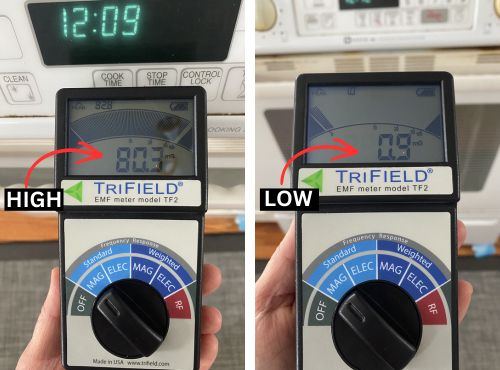
That’s one of the most useful things about the TF2’s magnetic mode: the readings respond immediately and dramatically to distance, so you can actually track a field back to its source and figure out exactly where it drops to an acceptable level.
AC Electric Fields. The electric field mode covers 1 to 1,000 V/m, which is more than enough range for home testing. The mode is single-axis, so you do need to be a bit more deliberate about orientation when measuring, but for most home use this isn’t a significant limitation. The readings respond quickly and the peak hold function is useful for catching momentary spikes near wiring.
I use this mode regularly in the bedroom, particularly around the headboard area where outlet wiring is often closer than people realize. The photo below shows exactly what I mean. Measuring practically at the outlet above my headboard with the TF2, I got 508 V/m. Two feet back it dropped to 6 V/m. Same outlet, same lamp, just distance.

RF Radiation. The RF mode covers 20 MHz to 6 GHz, which includes Wi-Fi, Bluetooth, cell signals, and most 5G frequencies used in residential areas. The range runs from 0.001 to 19.999 mW/m², which is broader than many consumer meters and means you’re less likely to hit the ceiling in typical home environments.
There are two things to understand about the RF mode before you use it. First, the TF2 displays RF in mW/m², while most building biology guidelines use µW/m². You multiply the TF2 reading by 1,000 to convert. It’s simple once you know it, but it catches a lot of beginners who compare their reading directly to a benchmark without converting. This is standard across most consumer meters at this price range, not a quirk specific to the TF2.
Second, the RF mode is single-axis, which means orientation matters when you’re pointing it at a source. This is also true of comparable meters including the GQ EMF-390, so it’s not a disadvantage unique to the TF2, just something to be aware of.
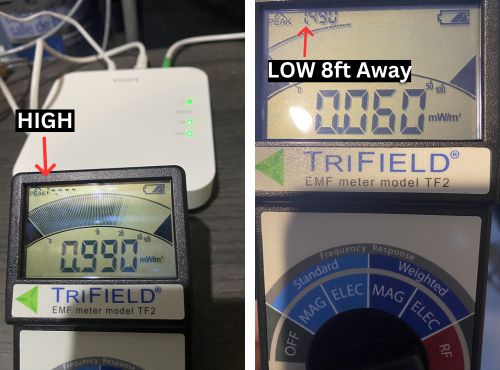
Because Wi-Fi signals pulse rather than transmit continuously, the live display window can look deceptively calm between pulses. The peak hold reading is what actually tells you what you’re dealing with. When I measured my old conventional router up close, the meter was peaking out entirely, exceeding its maximum RF range of 1.999 mW/m². Eight feet back, the peak settled at 1.49 mW/m². That’s the kind of real-world context the TF2 gives you once you know how to read it.
For most home testing purposes, the RF mode is useful and informative. If RF is your primary concern and you want calibration documentation alongside your reading, the Safe and Sound Pro II is worth looking at, though it’s worth knowing that meter measures RF only. It’s not an alternative to the TF2. It’s a complement to it for people who want a dedicated RF instrument alongside an all-in-one meter.
The Standard vs. Weighted Mode Question
The TF2 has two measurement modes for magnetic and electric fields: standard and weighted. This confuses a lot of people, including me when I first got the meter.
Standard mode measures the actual field strength as it is, flat across the frequency range. Weighted mode applies a filter that emphasizes certain frequencies based on older thinking about which parts of the EMF spectrum are most biologically relevant. The weighted mode will often produce a higher number on the same source.
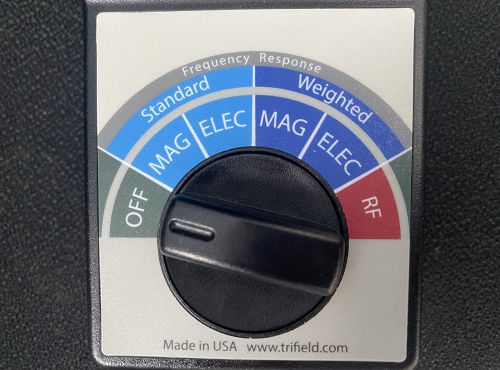
For home testing and comparing your readings to building biology benchmarks, use standard mode. The Institute for Building Biology and Ecology guidelines were developed using standard, unweighted measurements. If you measure in weighted mode and then compare to those thresholds, you’re comparing apples to oranges. I cover this in much more detail, including exactly when weighted mode is and isn’t useful, in the dedicated guide to Trifield TF2 standard vs. weighted mode.
What the TF2 Does Not Do
It does not measure dirty electricity. This isn’t a weakness specific to the TF2. No handheld EMF meter measures dirty electricity. It’s a fundamentally different type of measurement that requires a plug-in filter meter like the Greenwave or Stetzer. If dirty electricity is part of what you want to assess, that’s a separate tool regardless of which EMF meter you buy.
It does not data log. The GQ EMF-390 is my second meter specifically because it records readings over time and lets me see patterns rather than snapshots. If you want to know what the RF levels in your bedroom look like over an entire night while you sleep, the TF2 can’t tell you that.
Pros and Cons
Pros:
- Measures all three field types in one device
- 3-axis magnetic field measurement, no rotation needed
- Broad RF range up to 6 GHz, covers most 5G frequencies
- Built by a legitimate scientific instrument manufacturer
- Peak hold function on all modes
- Backlit display, easy to read
- Audible alert that responds proportionally to field strength, useful for tracking sources without watching the display
- Made in the USA
- Solid build quality for the price
Cons:
- RF mode is single-axis, requires deliberate orientation (standard for meters in this class)
- RF displayed in mW/m², requires conversion to compare to standard benchmarks (standard for meters in this class)
- No data logging
- Does not measure dirty electricity (true of all handheld EMF meters)
- Weighted mode causes confusion for new users
- RF sensitivity maxes out at 1.999 mW/m² peak, which close-range router testing can exceed
Check the current price here.
Who the Trifield TF2 Is Right For
It’s the right first meter for most people who want to understand the EMF environment in their home. If you’re starting from zero and you want a single device that lets you walk through every room and measure what’s actually there, the TF2 is what I’d recommend. It’s what I started with, and if I were buying my first meter today I’d buy it again.
It’s also a strong choice if magnetic and electric field testing is your primary focus. The 3-axis magnetic mode in particular is genuinely better than most consumer meters at this price.
It’s not the right only meter if RF is your primary concern and you want data logging and spectrum analysis. That’s exactly why I added the GQ EMF-390 as my second meter. The two together cover everything I need for thorough home testing. The TF2 is a strong foundation, and you can build from there based on what your testing actually shows you.
The price sits in the $160 to $200 range depending on where you buy it. Check the current price here. For what you get, that’s fair. There are cheaper meters. There are also meters that do individual things better. But for an all-in-one starting point that’s actually built by people who make scientific instruments, the TF2 earns its place as the default recommendation.
Frequently Asked Questions
A few of the questions I hear most often from people deciding whether the TF2 is the right meter for them, or trying to figure out how to use it once they have it.
Is the Trifield TF2 accurate enough for home testing?
Yes. For the purpose of walking through your home, identifying elevated areas, and taking before-and-after readings to see whether a change you made moved the numbers, the TF2 is accurate enough. It’s consistent, and consistency is what matters most for practical home testing. I’ve cross-referenced readings with other quality meters I own and the results are reliably in the same range.
What’s the difference between standard and weighted mode, and which should I use?
Standard mode measures actual field strength across the frequency range. Weighted mode applies a filter that emphasizes certain frequencies that were once thought to be most biologically significant, and it often produces higher readings on the same source. For home testing and comparing to building biology benchmarks, always use standard mode. The precautionary guidelines you’re comparing your readings to were developed using standard measurements. If you want the full picture on what weighted mode is actually doing and when it changes anything, I break it all down in Trifield TF2 standard vs. weighted mode.
Does the Trifield TF2 measure 5G?
It measures RF up to 6 GHz, which covers the sub-6 GHz 5G frequencies used by most current residential 5G deployments. It does not cover millimeter wave 5G frequencies above 6 GHz, which are primarily used in dense urban environments and some fixed wireless applications rather than typical residential settings.
Do I need a second meter alongside the TF2?
For a general home assessment covering all three field types, the TF2 alone is enough to get started. If you want to data log RF levels over time, you’d need something like the GQ EMF-390. If you want calibration-certified RF readings with a dedicated instrument, add the Safe and Sound Pro II. The TF2 is a strong foundation, and for most people starting out, it’s all they need for the first round of testing.
What battery does the Trifield TF2 use?
A standard 9V battery. One comes included in the box. Battery life is reasonable for intermittent home testing use, though if you’re doing extended measurement sessions you’ll want to keep a spare on hand.
Why does my live RF reading look so low when I know my router is nearby?
Because Wi-Fi signals pulse rather than transmit continuously. The live display window catches the signal between pulses and can look much lower than the actual peak output. Always use the peak hold reading when measuring RF from pulsing sources like Wi-Fi routers. That’s the number that reflects what the meter actually captured at maximum output.
Start Here, Then Go Deeper
The TF2 is the meter I used to take the readings referenced throughout this site, including the stove measurements in the magnetic field benchmarks article and the router readings in the RF section. It’s not a perfect meter, but it’s a real one, made by people who know what they’re doing, and it gives you genuinely useful information about your home.
If you’re ready to start testing, the home testing guide walks you through a room-by-room process using the TF2 as your primary instrument, including what to measure, where to hold the meter, and how to interpret what you find.