Author: Ryan

HAVN Wear Review: My Honest Take After Testing the Clothes

I own a lot of HAVN products. The boxer briefs, the baseball cap, the beanie, t-shirts, joggers, and the blanket. My wife has her own pieces and keeps reaching for them without me prompting her, which is probably the most honest endorsement I can offer.

Affiliate disclosure: Some links here are affiliate links. If you buy through them I may earn a small commission at no extra cost to you.

My Verdict

The WaveStopper fabric verifiably blocks RF signals. I confirmed this with my own meter and a simple phone-wrap test. Real-world shielding is lower than the lab’s 99.7% figure because garments have openings at the neck, cuffs, and hem, but the reduction is meaningful and measurable. Shop HAVN Wear · Free shipping over $200 · 30-day returns · HSA/FSA eligible

The clothes are comfortable enough that my wife wears them without any prompting from me. They’re expensive, but if reducing daily EMF exposure matters to you, this is the most practical way to do it.

My number one recommendation: Start with the boxer briefs. Specific use case, close body fit for maximum shielding, and you’re wearing underwear anyway.

Which HAVN Product Should You Buy First?

Boxer Briefs (Top Pick) Best for phone-in-pocket carriers, fertility-conscious men, and laptop users.

Baseball Cap Best for daily wear, outdoor use, and year-round head shielding.

Beanie (Best Value) Best for sleep use, cooler weather, and the lowest price entry point.

T-Shirt Best for all-day torso protection and remote workers.

Joggers Best as a companion to the boxers for full lower body coverage.

Blanket Best for couch and laptop use. Try a smaller piece first before committing.

Why the Physics Behind HAVN Actually Holds Up

HAVN by Lambs makes EMF shielding clothing using their WaveStopper fabric, a conductive mesh woven from pure silver fibers. The silver content varies by product but runs from around 32% in the boxers up to 40% or more in some items. Silver is highly conductive, and when woven tightly enough it creates what is essentially a wearable Faraday cage. Electromagnetic waves hit the conductive mesh and get redirected rather than passing through to your body.

This is not pseudoscience. It’s the same principle behind Faraday bags and military shielding enclosures, understood since Michael Faraday demonstrated it in the 1830s. The question for any shielding garment is whether the specific product executes it well enough to produce a meaningful real-world reduction.

HAVN’s WaveStopper fabric is tested and certified using IEEE-299 and EN 62209-2 standards, the same standards used for military-grade shielding, with third-party labs verifying the blocking effectiveness. That puts them in a different category from cheaper EMF clothing brands that make shielding claims without publishing any certification data.
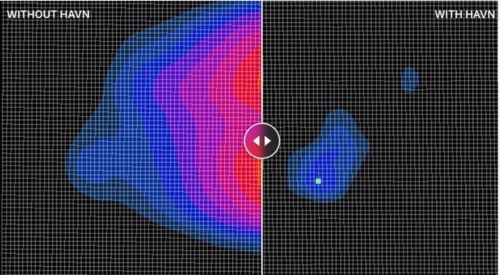
One thing worth understanding before we get into specific products: lab certification figures like 99.7% are measured on flat fabric panels in controlled conditions. What varies in real-world use is how well the garment stays close to your body. A fitted cap leaves fewer gaps than a shirt hanging off a torso, which is why headwear tends to shield more consistently when you’re actually wearing it.

The 99.7% figure describes the fabric, not the garment, and your real-world reduction will be lower than that. That doesn’t make the products ineffective. It means you should understand what you’re buying and why, which is exactly what this review is here for.

The Boxer Briefs

This was my first HAVN purchase. The use case is straightforward: most men carry their phone in their front pocket for hours every day, putting an RF source in close proximity to sensitive tissue on a sustained basis. A 2024 systematic review on RF-EMF exposure and decreased pregnancy rates and sperm count found the associations worth taking seriously even given the limitations of the existing research. Reducing that specific daily exposure seemed like a simple and reasonable thing to do.

The fit is good. They’re noticeably denser than standard cotton boxers because of the silver fiber content, but after the first wear you stop noticing the weight. Comfort is genuinely not an issue. The antimicrobial properties of the silver are real and noticeable. They stay fresher longer than regular cotton, which matters for something you’re wearing all day.

On the meter, holding the fabric between my phone and the TF2 showed a meaningful and visible reduction of about half. The result was clear on both meters.
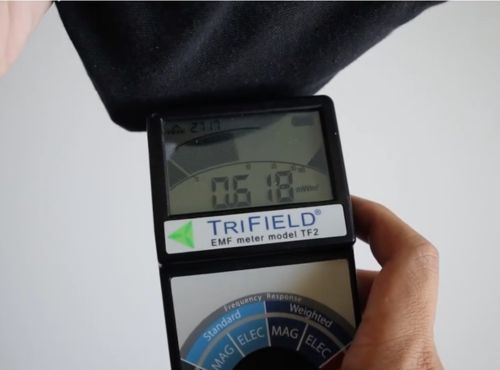
These are the product I’d recommend first to anyone new to HAVN. The use case is specific, the exposure scenario is real, and the shielding works well given how closely the garment fits the body.

What I like:

  • Close fit gives you the best real-world shielding of any HAVN product
  • Comfortable for all-day wear
  • Antimicrobial silver keeps them fresher longer
  • Specific, research-backed use case
  • You’re wearing underwear anyway, might as well make it count

Worth knowing:

  • These are expensive underwear
  • Silver requires care when washing: cold water, gentle cycle, no bleach, no fabric softener

My take: The strongest product in the lineup for real-world shielding. If you carry your phone in your pocket, this is where to start.

Shop HAVN Boxer Briefs

The Baseball Cap and Beanie

I wear the baseball cap regularly when I’m out and about. The beanie gets more use in cooler weather and when I want something comfortable to wear around the house in the evening. Both fit like normal headwear and nobody has ever commented on anything unusual about them.
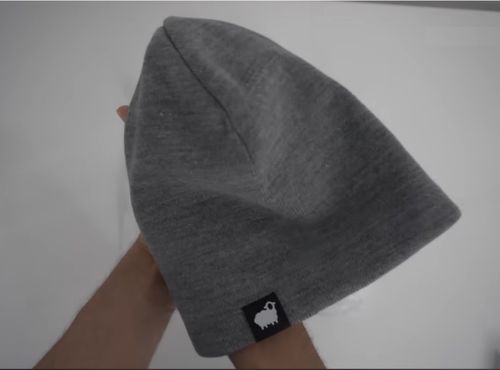
The WaveStopper beanie features an inner 360-degree silver lining certified to block 99.7% of EMF including cell phone radiation, 4G, 5G, Wi-Fi, and Bluetooth. The cap uses the same construction. On the meter, holding the fabric between the TF2 and an RF source showed a clear reduction, and the headwear performed most consistently in real-world use because a fitted cap or beanie sits close against the head with minimal gaps.

If you’re deciding where to start with HAVN, the headwear is my first recommendation over the shirts. The fit is closer to the body, the shielding is more consistent in everyday use, and the price point is lower.

What I like:

  • Most consistent real-world shielding of any product category
  • Looks like normal headwear
  • The beanie doubles as a sleep cap for overnight head shielding at the lowest price point

Worth knowing:

  • Beanie runs warm after extended wear since silver reflects heat as well as EMF. Fine in winter, may be too warm in summer
  • One-size fit may feel loose on smaller heads
  • Some users report HAVN headwear triggers TSA body scanners due to the silver content, worth considering if you fly frequently

My take: The most consistent performer in real-world use and the easiest product to incorporate into a normal daily routine. The beanie is the best value entry point in the entire lineup.

Shop HAVN Headwear

The T-Shirts

I own a couple of HAVN t-shirts and wear them on days when I’m spending extended time near devices or working with a laptop. The fabric is 63% cotton, 32% pure silver fibers, and 5% polyester, covering the full torso including the chest, stomach, and back.

The feel is softer than you’d expect given the silver content. They look and wear like normal t-shirts and nobody has noticed anything unusual about them.

The shirts are where the gap issue matters most in real-world use. RF can enter from the neckline, cuffs, and hem in a way it can’t with a fitted hat. The lab certification reflects what the fabric blocks, not what the shirt blocks as a complete garment on a person in a Wi-Fi environment. That’s not a reason not to buy them. It’s context for setting your expectations correctly. The meter showed a clear reduction when testing fabric against an RF source. The shirts feel good, hold up well to cold wash and hang dry, and I keep reaching for them on long work-from-home days.

What I like:

  • All-day torso coverage
  • Comfortable enough for genuine daily wear
  • Good for work-from-home setups where you’re surrounded by devices

Worth knowing:

  • More gaps in the garment mean lower effective shielding than close-fitting products like the boxers or headwear
  • Higher price point than the headwear

My take: A solid choice for long work-from-home days. Just go in with realistic expectations about what a shirt can shield versus what a fitted cap can.

Shop HAVN T-Shirts

The Joggers

The joggers extend the coverage that the boxers start. If you’re spending long stretches working from home, sitting with a laptop, or want lower body coverage during the day, they make sense as a companion to the rest of the line.
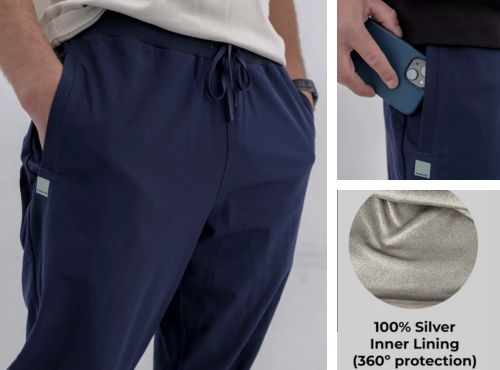
Comfort-wise these are genuinely good joggers independent of any EMF consideration. The fabric is soft, the fit is relaxed without being sloppy, and the silver content means they stay fresh longer during extended wear. The meter showed a meaningful reduction when testing the fabric, consistent with the rest of the line.

What I like:

  • Extends lower body coverage beyond the boxers
  • Genuinely comfortable as everyday joggers
  • Silver keeps them fresh during long wear

Worth knowing:

  • Same gap limitations as the t-shirts
  • Less essential than the boxers or headwear if you’re choosing where to start

My take: Worth it if you’re already wearing the boxers and want to extend your coverage. Not where I’d start if you’re new to HAVN.

Shop HAVN Joggers

The Blanket

The blanket is one of the most expensive items in the HAVN lineup and the one where I think the shielding physics works most reliably in everyday use. The WaveStopper blanket features fabric with over 40% pure silver and is certified to block over 99.7% of EMF including signals from cell phones, 4G, 5G, Wi-Fi, and Bluetooth.
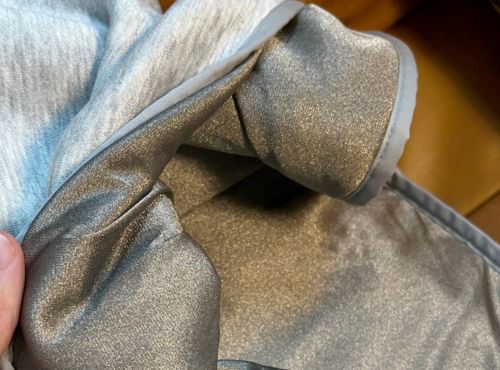
Here’s why the blanket outperforms the clothing from a pure shielding standpoint: when you drape it over your lap with a laptop on top, you’re creating a physical barrier between the device and your body that doesn’t have the gap limitations of a fitted garment. The blanket sits flat, covers completely, and the device is on the outside. That’s a more controlled shielding scenario than wearing a shirt in a room full of Wi-Fi.

I use it most when I’m working with my laptop on the couch. My wife uses it too without any prompting from me, which I take as a reliable signal that the comfort holds up independently of any EMF motivation.

It’s a significant purchase. I’d suggest trying a smaller HAVN piece first so you understand the fabric quality before committing to the blanket.

What I like:

  • Best shielding physics of any product in the lineup due to flat coverage with no gaps
  • Genuinely comfortable
  • Great for the specific laptop-on-lap scenario

Worth knowing:

  • Most expensive single item in the lineup
  • Try a beanie or boxer briefs first to evaluate the fabric quality before committing

My take: The best shielding physics of anything in the lineup, but a significant investment. Earn your way here after you’ve tried a smaller piece.

Shop HAVN Blanket

Is HAVN Worth the Price?

Here’s how the math works out when you think about cost per wear.

The boxer briefs at roughly $58, worn twice a week for a year, come out to about $0.56 per wear. The baseball cap at around $52, worn four times a week, works out to $0.25 per wear. The beanie at $48 used nightly for sleep drops to $0.13 per use. Compare that to a standalone Faraday phone pouch at $30 to $50 that only protects when your phone is sealed inside it and completely unreachable.

These aren’t impulse purchases. But when you break down the per-wear cost, the math is reasonable, especially for the headwear and boxers where you get the best shielding per dollar. The products I’ve tested have held up through regular washing with no degradation in fabric quality or shielding performance so far.

One more thing a lot of people don’t know: HAVN products are HSA/FSA eligible. You can use pre-tax health spending funds, which effectively reduces the price by whatever your tax bracket is.

What to Expect When Ordering

I want to be upfront here. HAVN’s Trustpilot reviews include some complaints about shipping delays and customer service response times. My own order arrived without issues, but it’s worth setting your expectations. Some items go on backorder periodically. If you need something by a certain date, order well ahead.

Their return policy is 30 days from delivery. If you do run into a shipping issue, email hello@havnwear.com and follow up if you don’t hear back within a few days. The complaints that got resolved were the ones where customers stayed persistent.

What I’d Push Back On

A few things HAVN says that deserve honest scrutiny.

The customer reviews claiming immediate elimination of brain fog, dizziness, and headaches within minutes of putting on a product are not something I’d take at face value. Placebo effects are real and well-documented, and the mechanism by which an EMF shielding garment would resolve dizziness within minutes isn’t supported by anything in the research. I’m not saying those customers aren’t experiencing something. I’m saying the attribution is worth questioning.

HAVN also uses language like “radiation-proof” in their marketing, which overstates what any garment can do in real-world conditions. The fabric is independently certified and my own meter testing confirmed real reductions. The specific health outcome claims go further than the evidence supports. I’d rather you buy these products knowing exactly what they do and don’t do than buy them based on marketing language and feel let down.

Who This Is For

If you carry your phone in your front pocket all day and you’ve looked at the fertility research and decided you want to reduce that specific daily exposure, start with the boxers. The physics is sound, my meter testing confirmed a meaningful reduction, and they’re genuinely comfortable.

If you want to start with something you’ll reach for every day regardless of season, the cap is a natural first purchase. It’s the most consistent performer in real-world use and the easiest to incorporate into a normal routine.

If you work long hours with a laptop and want to reduce torso exposure during the day, the shirts and joggers make sense as part of a broader reduction strategy. The blanket is worth it if laptop use on the couch is a regular part of your day.

If you’re brand new to EMF reduction and wondering whether to start here, my honest answer is no. Start by measuring your home, moving your router further from where you sleep, and turning off Wi-Fi at night. Those steps are free and produce measurable results. HAVN products make the most sense layered on top of that foundation, not as a substitute for it.

Frequently Asked Questions

These are the questions I get asked most often about HAVN. If something isn’t covered here, drop it in the comments.

Does EMF shielding clothing actually work?

The fabric produces a measurable reduction on an EMF meter, which I’ve confirmed personally across multiple products. Real-world effectiveness on a human body is lower than the lab certification figures because garments aren’t sealed enclosures. The effect is real. The 99.7% figure is a lab measurement on flat fabric, not a guarantee of what you’ll experience wearing a shirt in a Wi-Fi environment. I wrote an entire post answering the question does EMF shielding clothing actually work if you want to learn more.

Is HAVN the same as Lambs?

Yes. HAVN was formerly known as Lambs and rebranded. The products and WaveStopper technology are the same.

Which product should I buy first?

The boxer briefs. They address a specific, research-backed exposure scenario, they fit closely for maximum real-world shielding, and you’re wearing underwear anyway. If headwear is more relevant to you, the beanie offers the best value.

Can you wash HAVN products?

Yes, with care. Cold wash and hang dry or low tumble dry is what HAVN recommends and what I follow. I haven’t noticed any degradation in the fabric after regular washing on those settings.

Will HAVN products set off TSA scanners?

Possibly. Some users on Trustpilot report getting flagged by body scanners at airports due to the silver content. If you fly frequently, factor this in.

Can I use HSA/FSA funds to buy HAVN?

Yes. HAVN products are HSA/FSA eligible, which lets you pay with pre-tax health spending dollars and effectively lowers the cost.

What’s HAVN’s return policy?

30 days from delivery for a full refund if you’re not satisfied.

Do I need shielding clothing if I’ve already reduced my home EMF?

Not necessarily. If you’ve addressed your router, reduced bedroom exposure, and aren’t carrying your phone in your pocket for hours a day, the marginal benefit is smaller. Shielding clothing makes the most sense for specific sustained exposure situations you can’t otherwise control.

A Brand I Keep Buying From

I’ve tested a lot of EMF protection products. Some made a real difference. Some were a complete waste of money. HAVN sits firmly in the first category. The fabric is independently certified, the shielding mechanism is physically grounded, the quality is consistent across everything I own, and my meters confirmed meaningful reductions across the products I tested.

Take the more dramatic marketing language with some skepticism, and understand that real-world garment performance is always lower than a lab measurement on flat fabric. Buy these products for what they genuinely do: reduce your EMF exposure in a measurable way. That’s what I keep coming back for.

Shop HAVN Wear · Free shipping over $200 · 30-day money-back guarantee
Leave a Comment

What’s a Normal Reading on an EMF Meter?

If you’ve just picked up an EMF meter and looked at the display, there’s a good chance your first question is: is this reading high or low? The numbers can seem abstract without a reference point, and that’s exactly what this article is here to give you.

The short answer is that there’s no single universal definition of “normal.” But there are two very different frameworks for evaluating what your meter shows you, and understanding the gap between them is arguably more useful than any specific number. If you’re still deciding which meter to use for this, see the top EMF meters compared first.

Let me break it down by field type, explain where each set of guidelines comes from, and give you a clear picture of where the science actually stands.

Two Very Different Sets of Standards

Before we get to numbers, you need to understand something that trips a lot of people up. There are two completely different frameworks for evaluating EMF readings, and they produce thresholds that are sometimes millions of times apart.

Regulatory limits are set by organizations like ICNIRP and the FCC. These define the maximum exposure permitted under current international standards. The problem is that they are based almost entirely on thermal effects, meaning the level at which EMF can heat tissue.

They were largely established in the 1990s and have not been substantially updated to reflect decades of research into non-thermal biological effects. When your readings fall below regulatory limits, that tells you one thing: the signal probably isn’t cooking you. It doesn’t tell you much beyond that.

Precautionary guidelines are set by building biologists and environmental health researchers, most notably through the Institute for Building Biology and Ecology. These are not legally binding, but they are grounded in a broader reading of the available science, including research on non-thermal effects that regulatory bodies have been slow to incorporate. They are considerably more conservative, and in my view, considerably more useful as a practical reference for your home.

The gap between these two frameworks isn’t just a difference of opinion. It reflects a real and ongoing dispute in the scientific community about how EMF exposure should be evaluated. More than 400 scientists and medical doctors have signed the International EMF Scientist Appeal, calling on the WHO and UN to adopt stronger protections based on the existing body of research. These are not fringe voices. They are researchers who have spent careers studying this and believe the current regulatory limits don’t reflect what the science is showing.

This pattern isn’t without precedent. Regulatory bodies have historically lagged behind the science on environmental health issues, lead and asbestos being the most cited examples. That doesn’t mean EMF is the next asbestos. It means that waiting for regulatory certainty before taking simple, low-cost precautions is not necessarily the cautious choice.

The precautionary principle exists for exactly this situation: when the evidence is uncertain but the potential consequences are meaningful, it makes sense to act on what we know rather than wait for what we don’t. That’s the framework this article uses.

A note on where I stand: I’m not a doctor, and nothing here is medical advice. I’m not going to tell you EMF is definitely harmful at typical home levels, because the science doesn’t conclusively say that. What I will say is that the regulatory limits were not designed with your long-term health as the primary variable, and the researchers calling for stronger protections deserve to be taken seriously. Taking simple steps to reduce exposure in the places where you spend the most time strikes me as reasonable given what we currently know.

Normal Magnetic Field Readings

Magnetic fields are measured in milligauss (mG) and are produced by current flowing through wires. Every electrical appliance, power line, and piece of wiring in your home creates a magnetic field. Your meter’s magnetic field mode is what you use to measure these.

Precautionary benchmarks for magnetic fields:

  • Below 1 mG: low, considered acceptable in sleeping areas
  • 1 to 4 mG: moderate, worth investigating the source
  • Above 4 mG: elevated, worth taking action to reduce if possible

In a typical home, most areas away from appliances will read below 1 mG. You’ll often see higher readings close to running appliances, near the electrical panel, and in spots where wiring runs through the wall.

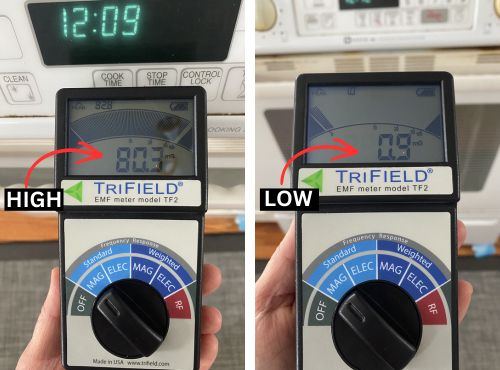
When I walk around my house with the Trifield TF2, most open rooms away from appliances read somewhere between 0.1 and 0.5 mG. Right next to the stove, I’ve measured over 80 mG. A foot or two back, it drops to essentially nothing. Distance matters a lot with magnetic fields.

The sleeping area focus in these benchmarks isn’t arbitrary. Magnetic fields drop off quickly with distance, which means the appliances you run briefly during the day are rarely the ones worth worrying about. What matters more is what’s close to you for hours at a time. A lamp plugged in behind the headboard or wiring running through the wall beside your bed is a different calculation than the stove you stand near for a few minutes while cooking.

Unit note: The Trifield TF2 reads magnetic fields in milligauss (mG). If you’re using a meter that shows microtesla (µT), multiply by 10 to convert to mG. So 0.1 µT equals 1 mG.

Normal Electric Field Readings

Electric fields are measured in volts per meter (V/m) and are produced by voltage in wires, even when no current is flowing. A lamp that’s plugged in but turned off still produces an electric field. This is one of the reasons building biologists pay particular attention to sleeping areas, where you may be within a few feet of in-wall wiring for hours at a time.

Precautionary benchmarks for electric fields:

  • Below 10 V/m: low, considered acceptable in sleeping areas
  • 10 to 50 V/m: moderate, worth considering changes
  • Above 50 V/m: elevated, building biologists typically recommend action

Electric field readings are often higher near the bed headboard if there’s wiring in the wall behind it, or near extension cords and power strips on the nightstand. Switching off circuits at the breaker while you sleep is one of the most effective steps you can take for electric field reduction in the bedroom, and it costs nothing.

I tested this in my own bedroom with the Trifield TF2. There’s an outlet on the wall above my headboard with a lamp plugged in. Measuring practically at the outlet, I got 508 V/m with a peak of 538. That’s well into the elevated range. About a foot back, it was down to 22 V/m. At two feet, it dropped to 6 V/m with a peak of 7, which sits comfortably in the low range.

Two feet of distance, no cost, and the reading went from elevated to low. If you can’t move the outlet, you can unplug the lamp before bed, push the bed frame a few inches further from the wall, or switch off that circuit at the breaker. Any of those options gets you the same result.

The sleeping area focus in these benchmarks isn’t arbitrary. It’s about cumulative exposure time. Eight hours a night in close proximity to an elevated electric field adds up in a way that a brief exposure during the day doesn’t. That’s the logic behind applying the most conservative benchmarks to the places where you sleep.

Normal RF Radiation Readings

RF radiation is measured in microwatts per square meter (µW/m²) and is what your meter detects from Wi-Fi routers, phones, smart meters, and other wireless devices. This is the reading that tends to vary the most depending on where you live and how many wireless devices are in and around your home.

Precautionary benchmarks for RF:

  • Below 10 µW/m²: recommended for sleeping areas, especially for sensitive individuals
  • Below 100 µW/m²: general precautionary benchmark for most people
  • 100 to 1,000 µW/m²: elevated, worth reducing where possible
  • Above 1,000 µW/m²: high, building biologists typically recommend action

For context, ICNIRP’s regulatory limit for RF at typical Wi-Fi frequencies sits around 10,000,000 µW/m² (that’s 10,000 mW/m² on a meter that displays in mW/m²). The precautionary benchmarks are not slightly more conservative. They are orders of magnitude more conservative. That gap exists because the precautionary guidelines are trying to answer a different question: not “at what level does this definitely cause harm” but “how low can we reasonably get given what we know.”

A note on how to read RF on your meter. When you’re measuring a Wi-Fi router, you’ll notice the standard display window jumping around constantly, often showing a reading that seems low or even near zero between pulses. That’s not a malfunction. Wi-Fi signals don’t transmit continuously. They pulse, and the gaps between pulses can make the live window look misleadingly calm. The number that actually tells you what you’re dealing with is the peak hold reading, which captures the highest value recorded since you started measuring. That’s the figure worth paying attention to.

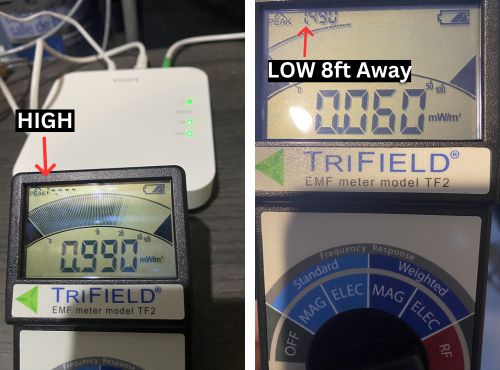
I tested this with my Trifield TF2 next to a conventional router, before I switched to the JRS Eco. Standing close to the router, the meter was peaking out entirely. The Trifield TF2 has a maximum RF range of 1.999 mW/m², and the signal was exceeding that ceiling. The standard display window was showing 0.990 mW/m², which is the top of its live measurement range, while the actual signal was higher than the meter could register.

I had to move back to at least eight feet before the peak hold reading finally stopped maxing out. At that distance I was reading 1.49 mW/m² peak with a standard window reading of 0.060 mW/m², which converts to roughly 1,490 µW/m² peak. That’s above the elevated threshold in the precautionary guidelines, and that was eight feet away.

The practical takeaway is straightforward. Keep your router out of the rooms where you spend the most time. Offices and bedrooms are the highest priority. I moved mine to the basement, where we spend the least time, and the difference in readings throughout the main living areas was immediate and significant.

What the WHO classification actually means. The WHO classifies RF radiation as a Group 2B possible carcinogen, a designation that’s often cited as evidence that there’s nothing to worry about. A 2B classification is frequently described as weak. What that framing leaves out is that the classification was made in 2011 and that multiple researchers who contributed to it have since publicly stated they believe the evidence now warrants a stronger classification.

The NTP study, one of the most comprehensive government-funded studies on RF radiation to date, found clear evidence of carcinogenic activity in animals. The Ramazzini Institute later replicated key findings at exposure levels closer to what people actually encounter in daily life. Neither study is definitive on its own. Together they are part of why hundreds of researchers have formally called for stronger protections. The science has not stood still.

After switching to the JRS Eco router, which reduces RF output when idle and only transmits actively when a device is actually using the internet, readings in standby dropped significantly compared to the conventional router. It’s one of the changes I’ve made that showed up clearly on the meter and that I’d recommend without hesitation.

If RF is your main concern: Wi-Fi routers are often the largest RF source in a home. The easiest first step is to measure the difference between standing near the router versus further back. RF drops quickly with distance, and where you place the router matters more than most people realize.

All Three Field Types at a Glance

Here are the precautionary benchmarks across all three field types, based on Institute for Building Biology and Ecology guidelines. These apply primarily to sleeping areas, where cumulative exposure time is highest.

Magnetic Fields (mG)

  • Low: below 1 mG
  • Moderate: 1 to 4 mG
  • Elevated: above 4 mG

Electric Fields (V/m)

  • Low: below 10 V/m
  • Moderate: 10 to 50 V/m
  • Elevated: above 50 V/m

RF, sensitive individuals (µW/m²)

  • Low: below 10 µW/m²
  • Moderate: 10 to 100 µW/m²
  • Elevated: above 100 µW/m²

RF, general precaution (µW/m²)

  • Low: below 100 µW/m²
  • Moderate: 100 to 1,000 µW/m²
  • Elevated: above 1,000 µW/m²

What to Do If Your Readings Are High

If your readings are above the precautionary benchmarks, the first step is source identification. Knowing where a reading is coming from tells you what you can actually do about it.

For magnetic fields: identify the appliance or wiring that is the source. Check the electrical panel, the stove, and any devices near where you sleep. Distance is your primary tool.

For electric fields: check for wiring in the wall behind your bed, power strips near the sleeping area, and devices that are plugged in but not in use. Switching circuits off at the breaker is the most effective approach when the source is in-wall wiring.

For RF: identify the strongest source, usually a Wi-Fi router or a phone on the nightstand. Distance, turning off Wi-Fi at night, or switching to a low-EMF router are the most practical reduction steps.

The home testing guide on this site walks through a room-by-room process for doing exactly this, including how to take before-and-after readings to confirm whether a change you made actually moved the numbers.

Why Location and Duration Matter as Much as the Number

One thing worth knowing is that the same number can mean very different things depending on where and when you measure it.

A magnetic field reading of 3 mG right next to a running hairdryer is expected and not particularly meaningful. The same reading at pillow height in the bedroom, sustained across eight hours every night, is a different calculation entirely.

The precautionary guidelines are specifically calibrated for sleeping areas because that’s where cumulative exposure is highest. A brief spike near an appliance you use for a few minutes is not the same as a chronic low-level exposure in the place where your body is supposed to be resting and recovering.

This is also why the testing process matters as much as the numbers themselves. Measuring at body height, in the places where you actually spend time, and over the course of a normal day gives you a far more accurate picture than a single spot check near the router.

Frequently Asked Questions

These are the questions I see come up most often from people who are just getting started with home EMF testing.

Are building biology guidelines the same as safety limits?

No. Building biology guidelines are voluntary precautionary benchmarks, not regulatory safety limits. Regulatory limits from bodies like ICNIRP are based on thermal effects and are orders of magnitude higher. The precautionary guidelines reflect a broader reading of the research, including non-thermal biological effects that the regulatory framework has been slow to incorporate.

What unit does an EMF meter use for RF?

Most consumer meters display RF in microwatts per square meter (µW/m²). Some meters also show milliwatts per square meter (mW/m²). To convert: 1 mW/m² equals 1,000 µW/m². The precautionary benchmarks in this article are in µW/m².

How do I know if my meter is accurate enough to use these benchmarks?

For general home testing, a well-regarded consumer meter like the Trifield TF2 is accurate enough to give you useful relative readings. The most important thing is consistency: measuring before and after a change, or comparing different spots in your home. For precisely calibrated RF readings, the Safe and Sound Pro II is the only widely available consumer meter that ships with independent calibration documentation.

Do these benchmarks apply to outdoor readings too?

They can be used as a reference outdoors, but the guidelines are primarily intended for indoor living and sleeping areas. Outdoor readings near cell towers can vary significantly and are harder to act on directly.

Is there a safe level of EMF exposure?

Regulatory bodies say yes, within their defined limits. Building biologists and a growing number of researchers say those limits don’t reflect the full picture of what the science shows. My honest take: the regulatory limits were not designed with long-term non-thermal effects in mind, and the researchers pushing for stronger standards have put forward a serious body of evidence. Taking simple precautions in the places where you spend the most time is a reasonable response to that uncertainty.

Your Numbers Mean More Once You Know What’s Behind Them

The benchmarks in this article give you a starting point. But what makes them useful is understanding what they’re actually measuring and why the two frameworks produce such different thresholds.

Regulatory limits tell you whether you’re in immediate physical danger from a thermal standpoint. Precautionary guidelines tell you something more useful for everyday life: how your home compares to what building biologists and environmental health researchers consider low exposure given everything the science currently shows, including the parts that haven’t made it into official policy yet.

If your readings are above the precautionary benchmarks in your sleeping areas, that’s worth acting on. The steps are simple, most of them are free, and the case for taking them is stronger than the official limits suggest.

Leave a Comment