Yes, most decent RF meters can detect the 5G nearly everyone actually receives, because most American 5G travels on frequencies below 6 GHz that good consumer meters already cover.
But almost no consumer meter can detect millimeter-wave 5G, the rare high-band variety, and several popular meters miss part of mainstream 5G because their range quits at 3.5 GHz.
So the real answer depends on one line of your meter’s spec sheet: the frequency range. This page shows you exactly how to read it.
It’s the companion to my best RF meters guide, where every ranked meter’s 5G coverage is flagged.
First, 5G Is Three Different Things
“5G” is one logo on three very different radio layers, and your meter’s answer differs for each.
Low-band 5G (roughly 600 to 900 MHz) is the coverage layer, the 5G that blankets suburbs and rural highways. It behaves like the cellular signals networks have used for decades.
Mid-band 5G (roughly 2.5 to 3.98 GHz) is where the speed lives. T-Mobile runs 2.5 GHz, and Verizon and AT&T built their flagship networks on C-band, roughly 3.7 to 3.98 GHz.
Millimeter-wave 5G (24 GHz and up) is the exotic layer: blazing fast, deployed on scattered urban blocks and stadiums, barely able to penetrate a wall or even a leaf. For nearly every American address, it’s not part of daily life.
What Your Meter Can See, Layer By Layer
Coverage isn’t uniform across the three layers, and this is where most spec sheets get vague on purpose. Here’s how a typical consumer meter stacks up against each one.
Low-band: almost any real RF meter sees it. If the range starts at or below 600 MHz, you’re covered. (One footnote from my reviews: the Safe and Sound Pro II’s specified response starts at 400 MHz, comfortably below the lowest 5G band.)
Mid-band: this is where meters quietly fail. Several popular models have RF ranges that end at 3.5 GHz, which misses C-band by a fraction of a gigahertz.
That means a LATNEX AF-3500, HF-B3G, or Tenmars TM-190 is blind to the marquee Verizon and AT&T 5G signal entirely. The TriField TF2 (to 6 GHz) and the Safe and Sound Pro II (to 8 GHz) both cover it properly.
Millimeter-wave: no ordinary meter, period. Consumer meters top out around 8 to 10 GHz on their most generous claims, and mmWave starts at 24 GHz.
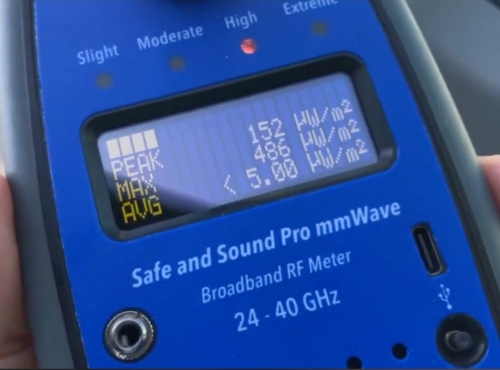
Measuring it takes a specialized instrument, and I own the main consumer option: the Safe and Sound Pro mmWave, which covers 20 to 40 GHz. My review explains why most people shouldn’t buy it, and who’s the genuine exception.
The Quick Reference Table
| Meter | Low-band 5G | Mid-band incl. C-band | mmWave |
|---|---|---|---|
| Safe and Sound Pro II | Yes | Yes | No |
| TriField TF2 | Yes | Yes | No |
| Cornet ED88T Plus | Yes | Yes (frequency readout to 4.2 GHz) | No |
| GQ EMF-390 | Yes | Claimed; undocumented above ~2.5 GHz | No |
| LATNEX AF-5000 | Reference-only below 1 GHz | Yes | No |
| LATNEX AF-3500 / HF-B3G / Tenmars TM-190 | Yes | No (3.5 GHz ceiling) | No |
| Safe and Sound Pro mmWave | No | No | Yes (20 to 40 GHz) |
One Caution About “10 GHz” Claims
A frequency ceiling printed on a box is only as good as the response data behind it.
The GQ EMF-390 advertises coverage “up to 10 GHz” with no published response curve, and its own spectrum tools stop at 2.5 GHz. My rule from that review: trust it in the 2.4 GHz neighborhood, and treat its readings at C-band and above as detection of unknown efficiency.
The same skepticism applies doubly to anything on Amazon with ‘5G detector’ in the title. The word is free to put on a listing, and the actual response data behind it usually doesn’t exist, so these devices are often measuring far less than the name implies.
How To Tell If A Reading Is Actually 5G
Here’s the honest limitation of every broadband meter: it sums everything in its band into one number and can’t label the source.
So a reading near a tower could be 5G, LTE, or both. Three ways to narrow it down.
The free way: distance and direction. Walk toward and away from the suspected tower and watch the trend.
The feature way: the Cornet ED88T Plus displays the dominant signal’s frequency up to 4.2 GHz, so a readout near 3,700 to 3,980 is C-band 5G by definition. The Pro II’s audio signatures give tower signals a recognizable cadence.
And the practical way: it rarely matters which generation the signal is. Same physics, same limits, same distance behavior, and your exposure question is answered by the level, not the logo.
What 5G Readings Actually Mean
Whatever your meter shows near 5G infrastructure, the context is the same as all RF: FCC and ICNIRP limits sit around 10,000,000 µW/m² time-averaged, and tower signals at ground level measure at tiny fractions of that.
Your own phone remains the dominant RF source in your life, 5G or otherwise, because it’s the transmitter that touches you.
The Spec-Sheet Answer
Can an RF meter detect 5G? Read the frequency range: at or below 600 MHz on the bottom and above 4 GHz on the top covers everything that matters at nearly every address, the 3.5 GHz ceiling meters miss the best half, and millimeter wave belongs to one specialized instrument most people don’t need.
Which is this whole site’s meter lesson in miniature. The band decides what the meter can see, and the spec sheet tells you before the checkout page does.
Sources
- FCC: 5G And Spectrum Information
- FCC: Wireless Devices And Health Concerns
- ICNIRP Radiofrequency Guidelines (2020), covering frequencies to 300 GHz
- Manufacturer frequency-range specifications, cited per meter in my individual reviews
This article is for general information and isn’t medical advice. Medical disclaimer.