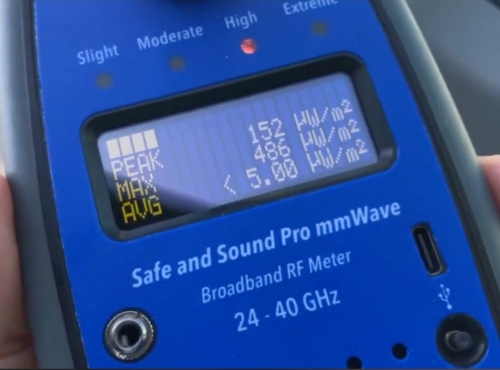
An RF meter measures the strength of radiofrequency fields, the wireless signals from phones, Wi-Fi, Bluetooth, smart meters, and cell towers. Most display that strength as power density, typically in microwatts per square meter (µW/m²), across a stated frequency range, with live, peak, and average readings.
That’s the short answer. The rest of this page unpacks each piece, because every phrase in that sentence hides a spec that separates good meters from disappointing ones.
Power Density, Explained With A Light Bulb
Power density measures how much RF energy is passing through a given area of space, right where the meter is standing.
Think of a light bulb. The bulb has a wattage, but what matters to your eyes is the brightness at your spot in the room, which drops fast as you back away.
An RF meter reads the brightness, not the wattage. It tells you what’s arriving at that exact location, which is why the same router reads enormous at contact and tiny across the room.
That’s also why an RF meter can’t tell you a transmitter’s power output. It measures your spot, and your spot is what your exposure actually is.
The Units You’ll See
Most references, including this site, use µW/m². Some meters display mW/m² (multiply by 1,000 to get µW/m²) or µW/cm² (multiply by 10,000).
Others show field strength in volts per meter (V/m), which relates to power density by a square law rather than a simple multiplication. The practical move: set your meter to µW/m² if it offers the choice, and stay there.

“Broadband” Means One Number For Everything
Nearly every consumer RF meter is a broadband instrument. It sums all the RF energy across its entire frequency band into a single reading.
That’s powerful and blunt at the same time. The number tells you how much is present, and nothing about what’s transmitting it.
A reading of 500 µW/m² could be the router, a phone, the neighbor’s smart meter, or all three. That’s why the better meters add identification aids: the Safe and Sound Pro II’s audio signatures let you recognize sources by their rhythm, and the Cornet ED88T Plus adds a frequency readout.
The reliable identification method costs nothing, though: turn the suspected source off and watch the number.
The Frequency Band Is The Spec That Decides Everything
An RF meter only measures frequencies inside its stated range, and this is the single most important line on any spec sheet.
Modern American wireless spans roughly 600 MHz to 6 GHz for the signals that matter at home: low-band cellular, mid-band including C-band 5G near 4 GHz, both Wi-Fi bands, Bluetooth, and smart meters.
Several popular meters have RF ranges that quit at 3.5 GHz, which makes them blind to 5 GHz Wi-Fi and C-band 5G, half of a modern home’s wireless.
The habit to build: read the frequency range before the price tag.
Peak And Average Are Two Different Questions
Modern signals pulse. A router transmits in millisecond bursts, a smart meter chirps intermittently, and a phone spikes during handshakes.
So RF meters report two numbers. The average tells you exposure over time, which is what official limits are defined against. The peak tells you the strongest burst, which is what identifies pulsed sources.
The gap between them is enormous by design; my own smart TV reads peaks around 400 times its average. A meter without a peak or max-hold function silently misses the bursts, which is one of the quiet differences between the meters in my rankings.
What An RF Meter Does Not Measure
An RF meter is built for one job, so it’s just as important to know what falls outside its range. A few things people often assume it covers, but doesn’t:
Magnetic and electric fields from wiring and appliances. Those are low-frequency fields, a completely different phenomenon needing a gauss meter or a 3-in-1.
Ionizing radiation. An RF meter is not a Geiger counter. Nuclear radiation, X-rays, and radon live on entirely different instruments.
SAR or absorption. A meter reads the field in the air, not what your tissue absorbs and no handheld device measures it.
Health effects. A meter reports field levels, not health effects. What those levels mean is a matter of interpretation, comparing readings against official exposure limits and understanding typical values in different environments, which is a broader topic than this page covers.
Two Honest Fine-Print Items
Single-axis vs. triaxial. Most affordable RF meters read one orientation at a time, so proper technique means rotating the meter at each spot and keeping the maximum. Triaxial models read all directions at once.
Accuracy is loose, everywhere. Broadband RF meters carry tolerances around ±6 dB, a factor of four, even at the premium end. That’s why every guide on this site teaches comparative measurement, before versus after, here versus there, where the tolerance cancels out.
The One-Sentence Version
An RF meter measures the strength of wireless signals arriving at its location, in power density, across whatever frequency band its designers gave it, and the band, the peak function, and honest comparative technique determine whether its numbers mean anything.
Now the spec sheets in my best RF meters guide will read like plain English, which is the entire point of this page.
Sources
- FCC: Wireless Devices And Health Concerns (exposure limits context)
- ICNIRP Radiofrequency Guidelines (2020), reference levels in power density
- Manufacturer specifications referenced throughout my individual meter reviews
This article is for general information and isn’t medical advice. Medical disclaimer.