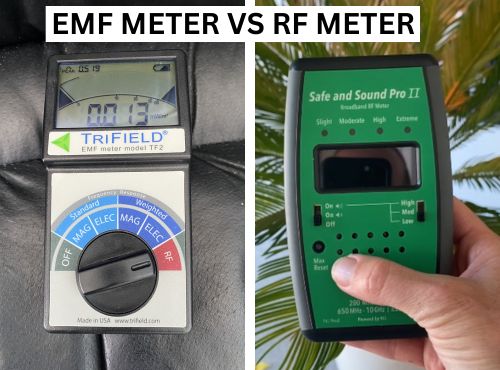
If you’ve started shopping for equipment to test your home, you’ve probably noticed that some products are labeled “RF meters” and others are called “EMF meters.” It’s easy to assume they measure the same thing. They don’t, and buying the wrong one means you’ll miss most of what’s actually in your environment.
This is one of the most common points of confusion for people just getting into home testing, so let’s clear it up properly.
What EMF Actually Covers
EMF stands for electromagnetic fields, but that term is broader than most people realize. It’s an umbrella that includes several distinct types of fields, each with different sources, frequencies, and measurement units.
The three types you’ll encounter most in a home testing context are:
Magnetic fields come from electrical current flowing through wires, appliances, and power lines. They’re measured in milligauss (mG) or microtesla (µT). Magnetic fields pass through walls easily, which is why proximity to wiring matters even when you can’t see it.
Electric fields come from voltage, meaning they’re present even when a device isn’t turned on, as long as it’s plugged in. They’re measured in volts per meter (V/m). Electric fields are more easily blocked by materials than magnetic fields are.
Radiofrequency (RF) radiation travels as waves through the air and is emitted by wireless technology all around us. Your Wi-Fi router, cell phone, smart meter, and Bluetooth devices all produce RF. It’s measured in microwatts per square meter (µW/m²) or milliwatts per square meter (mW/m²).
What an EMF Meter Does
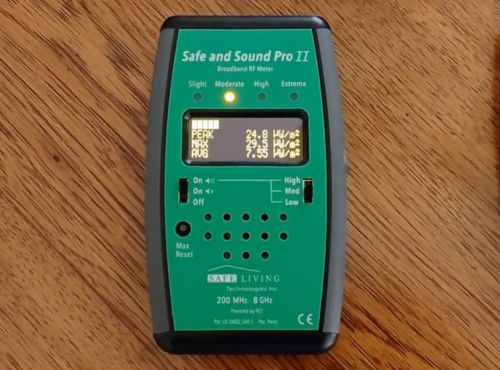
An all-in-one EMF meter measures multiple field types in a single portable device, typically magnetic fields, electric fields, and RF radiation. Some models measure all three with dedicated sensors. Others switch between modes manually.
When I started testing my own home, I used the Trifield TF2 as my primary EMF meter. It covers magnetic fields, electric fields, and RF in one handheld unit. That flexibility was exactly what I needed at the start, because I didn’t know which field type was going to be the most relevant in different parts of my house. The answer, as it turned out, was different in nearly every room.
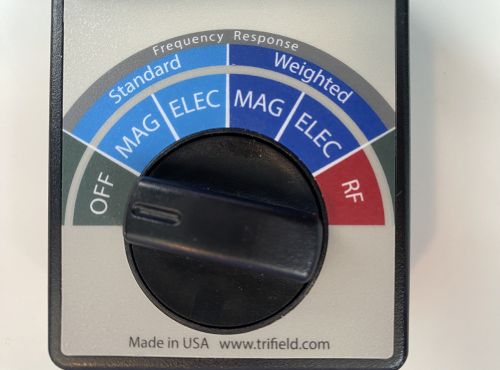
An EMF meter is usually the right starting point for most people because it gives you a complete picture. You can identify whether a specific spot has elevated magnetic fields from wiring, elevated electric fields from plugged-in devices, or elevated RF from wireless sources, all without buying three separate pieces of equipment.
What an RF-Only Meter Does
An RF meter is a type of EMF meter that focuses entirely on radio frequency detection. It’s designed specifically to pick up the wireless signals that saturate most modern homes: Wi-Fi, 5G, cell towers, Bluetooth, baby monitors, cordless phones, smart appliances, and more.
RF meters are typically the tool of choice when you want to find the highest RF exposure areas in your home, run a comparison of routers or phones by emission level, test whether a shielding product is actually reducing RF in a specific location, or get a sense of what your local cell tower environment looks like from inside your house.
A good RF meter will show you both peak readings and average readings. Peak readings tell you the momentary spikes that occur when a device transmits. Average readings give you a better sense of what you’re living with over time.
Do Dedicated RF Meters Detect More Than a Standard EMF Meter?
This is worth addressing directly because the answer surprises people. A dedicated RF meter doesn’t necessarily detect higher signal levels than a standard EMF meter, but it tends to pick up weaker signals more accurately. EMF meters split their design across multiple field types, and the RF sensor in an all-in-one unit is typically less sensitive, which can create interference with accurate low-level RF measurements.
In practice, this means an EMF meter like the Trifield TF2 may show little or no RF activity in a location where a dedicated RF meter would register a measurable signal. For a general home safety assessment, the TF2 is more than capable of identifying meaningful RF sources. But if you’re trying to confirm that RF in a specific spot is genuinely low, or you’re testing the performance of a shielding product, a dedicated RF meter gives you more confidence in what the numbers actually mean.
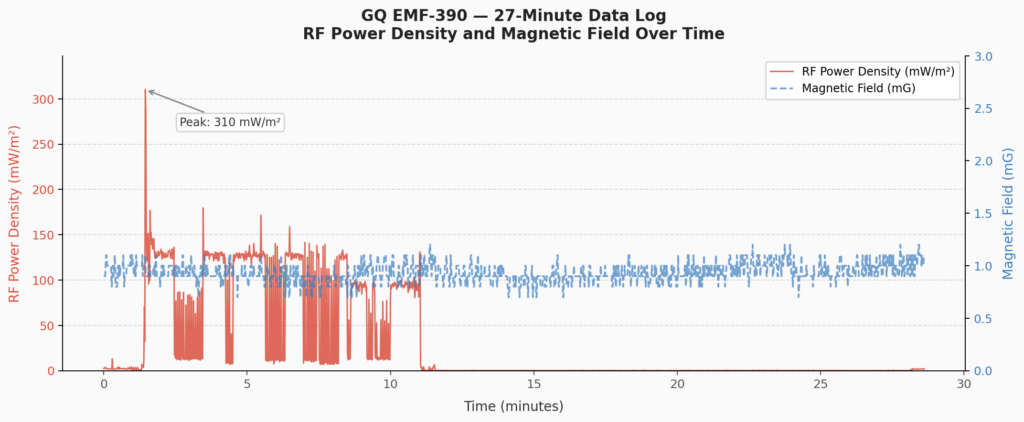
The GQ EMF-390, which I added after the Trifield, is still a standard EMF meter that measures magnetic fields, electric fields, and RF. Its advantage is data logging and RF spectrum analysis, which lets you track readings over time and spot patterns a single spot measurement would miss. That’s useful for understanding how your environment changes throughout the day, not for getting more sensitive RF measurements than a standard EMF meter provides.
The Limitation Nobody Talks About
Here’s what most buying guides skip: an RF meter will not tell you anything about the magnetic and electric fields in your home. And those fields matter.
Magnetic field exposure from wiring is one of the most studied areas in the EMF research literature. The IARC monograph on ELF electric and magnetic fields classified extremely low frequency magnetic fields as possibly carcinogenic to humans, based largely on epidemiological associations with childhood leukemia. The NIEHS echoes this, noting that while the evidence is not conclusive, ELF magnetic fields cannot be recognized as entirely safe. If you only have an RF meter, you’re completely blind to this part of your environment.
I’ve tested homes where the RF levels were modest and the magnetic field levels near certain walls or appliances were surprisingly high. Someone relying only on an RF meter would have walked away thinking everything was fine.
Which Type of Meter Should You Buy?
The honest answer depends on what you’re trying to learn, and the choices you make here will shape how useful your testing actually is.
Buy a standard EMF meter if: You’re new to home testing, you want to understand your full exposure picture, or you’re doing a room-by-room assessment for the first time.
Buy a dedicated RF meter if: You already have an EMF meter and want more sensitivity on the wireless side, you’re doing specific shielding tests where accuracy at lower signal levels matters, or RF from cell towers and routers is your primary concern.
Consider adding a data-logging EMF meter like the GQ EMF-390 if: You want to track how RF levels in your home change over time, or you want spectrum analysis to understand which frequency bands are contributing most to your readings.
For specific recommendations on which meters are worth the money, you can find my full breakdown of the best EMF meters for home testing and protection with readings, real-world results, and what I’d buy if I were starting over today.
Frequently Asked Questions
Here’s what most people want to know before they buy their first meter.
What is the difference between an RF meter and an EMF meter?
An RF meter is a type of EMF meter built specifically for radio frequency detection, picking up signals from Wi-Fi routers, cell phones, and Bluetooth devices. A standard EMF meter can also measure magnetic fields and electric fields from wiring and appliances. RF is one type of EMF, but a dedicated RF meter won’t pick up the other field types, and not all EMF meters are sensitive enough to detect weak RF signals accurately.
Is RF a form of EMF, or are they different things?
RF is a type of EMF. Electromagnetic fields span a wide spectrum, and radiofrequency waves sit at the higher-frequency end of the non-ionizing range. The lower end includes extremely low frequency magnetic fields from power lines and home wiring. They’re related but come from different sources, operate at very different frequencies, and need different sensors to measure properly.
Do cell phones emit RF radiation?
Yes. Cell phones transmit and receive data wirelessly using radiofrequency signals. Every time your phone connects to a cell tower, sends a text, loads a webpage, or syncs an app, it’s emitting RF radiation. The amount varies based on signal strength, how the phone is used, and how close it is to your body. Carrying your phone in a pocket or holding it directly to your head results in closer proximity to the RF source than using speakerphone or air tube headphones.
How much RF radiation does your phone emit while you sleep?
That depends on what your phone is doing overnight. If it’s on and connected to Wi-Fi or a cell network, it’s still syncing apps, receiving notifications, and emitting RF, even while you’re not using it. Measured on a meter, a phone sitting on a nightstand will show lower peaks than one actively in use, but it won’t read zero. Most phones also pulse RF intermittently as they check in with the network. The simple precaution is to keep it across the room, switch it to airplane mode, or use a dedicated alarm clock so the phone doesn’t need to be near your head for eight hours.
Is Wi-Fi a source of EMF or RF?
Wi-Fi is RF, and RF is a type of EMF, so it’s both. Wi-Fi routers operate in the 2.4 GHz and 5 GHz frequency bands and emit radiofrequency radiation continuously, even when no device is actively downloading anything. Standard routers pulse RF at regular intervals as part of how the protocol works. Low-emission routers like the JRS Eco are designed to reduce this idle pulsing, which can make a measurable difference on an RF meter.
Start With One Good Meter, Then Add From There
The single most useful thing you can do is pick up a solid EMF meter and spend a few hours walking your home. You’ll find things that surprise you. Some will be higher than you expected. Some spots you assumed would be bad will turn out to be fine.
That hands-on experience, those actual numbers in specific rooms, is worth more than anything you’ll read in a buying guide, including this one. Once you know your environment, you can decide whether a dedicated RF meter fills a real gap for you.
Start measuring. The rest follows.
This article is for informational purposes only and does not constitute medical or health advice. Always consult a qualified healthcare professional with any concerns about your health or environment.