After spending some time understanding what EMF actually is, I assumed buying a meter would be straightforward. I’d find something with decent reviews, order it, and get started.
What I didn’t realize is that EMF meters are not interchangeable. Different meters measure different types of fields, and if you buy the wrong one for what you’re trying to test, you’ll either get useless readings or nothing at all. I learned this the hard way with my first purchase, which measured magnetic fields just fine but couldn’t detect RF from my Wi-Fi router at all.
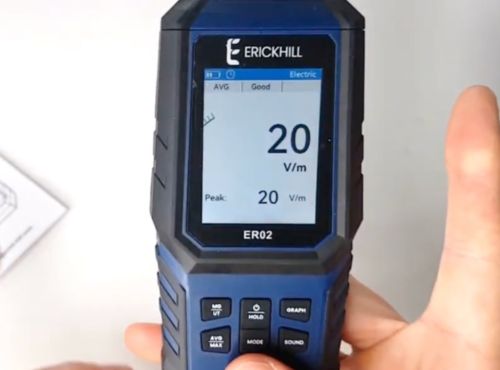
Once I understood the categories, everything got a lot clearer. Here’s what you actually need to know before buying anything.
Start With What You Want to Measure
This is the question that matters most, and it’s the one most people skip.
EMF is a broad term that covers several different types of electromagnetic fields. Magnetic fields, electric fields, and radio frequency radiation are all technically EMF, but they come from completely different sources and require different sensors to detect. A meter built for one type won’t necessarily measure another at all.
If you’re concerned about your Wi-Fi router and cell phone, you need something that measures radio frequency. If you’re concerned about the wiring in your walls or a household appliance, you need something that measures low-frequency magnetic and electric fields. If you want to assess your home across all three, you need a combo meter.
Getting clear on this first eliminates most of the confusion.
Single-Axis vs. Tri-Axis
This distinction affects how easy the meter is to use in practice, and it’s worth understanding before you buy.
A single-axis meter has one sensor that only detects fields coming from one direction at a time. To get an accurate reading, you need to rotate the meter slowly until you find the orientation that gives you the highest number. It works, but it takes more time and it’s easy to miss the peak reading if you’re moving too quickly.
A tri-axis meter has three sensors arranged at right angles, measuring from all three directions simultaneously. The result is a combined total field strength that doesn’t depend on how you’re holding the meter or where the source is relative to you. It’s faster, more reliable for scanning, and significantly more convenient for regular use.
The price difference between single-axis and tri-axis models is usually in the $50 to $100 range. If you’re planning to use the meter more than a handful of times, tri-axis is worth it. Both meters I use regularly are tri-axis.
ELF Meters
ELF stands for extremely low frequency. These meters measure the magnetic and electric fields produced by household wiring, electrical panels, appliances, and power lines.
Readings are displayed in milligauss (mG) or microtesla (µT), which are two different units for the same measurement. In the US, mG is the more common unit. You’ll also see some meters display electric fields in volts per meter (V/m).
ELF meters are useful for testing anything connected to your home’s electrical system. Appliances like refrigerators, microwaves, and electric blankets all produce measurable low-frequency fields. So does the wiring inside your walls, especially near the bed where you sleep.
The NCI notes that magnetic field levels are highest near the source and drop off rapidly within about a foot of most appliances.
One important thing to know: ELF meters do not measure RF from wireless devices. If that’s what you’re primarily concerned about, you need an RF meter or a combo.
ELF meters are generally the most affordable category. Solid options exist in the $50 to $100 range.
RF Meters
RF meters detect radio frequency emissions from wireless devices. Wi-Fi routers, cell phones, Bluetooth devices, smart meters, baby monitors, and cell towers all fall into this category.

The most important specification to check on an RF meter is the frequency range. Different wireless technologies operate at different frequencies. Standard Wi-Fi runs at 2.4 GHz and 5 GHz. Many 5G signals operate well above that, sometimes exceeding 10 GHz depending on the band. If your meter’s range tops out at 3 GHz, it won’t detect anything above that threshold regardless of what’s actually in the environment.
For most home testing, a frequency range up to 8 GHz covers the majority of common sources. If you have specific concerns about higher-frequency 5G bands, you’ll need a meter that goes further.
RF meters typically start around $100 to $150 for models suited to home use.
Gaussmeters
Gaussmeters are specialized instruments designed specifically to measure magnetic fields, usually from power sources like electrical panels, transformers, and power lines.
For most home testing purposes, a quality ELF meter covers magnetic field measurement adequately. A dedicated gaussmeter becomes relevant if you need highly precise measurements, are investigating an industrial environment, or are doing work that requires more detailed magnetic field data than a standard ELF meter provides.
For general home use, it’s not a necessary purchase alongside a good ELF or combo meter.
Combo Meters
Combo meters measure magnetic fields, electric fields, and radio frequency all in one device. They’re the most practical starting point for someone who wants a general picture of their home environment without buying multiple meters.
The tradeoff is sensitivity. A combo meter at a given price point will generally be slightly less sensitive in each category than a dedicated meter at the same price. For most home testing, that difference is not significant. But if you’re trying to detect weak RF from a distant cell tower or need precise low-frequency measurements, a dedicated meter will outperform a combo.
The Trifield TF2, which is the meter I use most often, is a combo. For the kind of room-by-room home testing I do regularly, it handles everything I need. I added the GQ EMF-390 later when I wanted more detailed RF spectrum data and the ability to log readings over time.
If you’re not sure which combo meter makes sense for your situation, this breakdown of the meters I’ve personally tested walks through what each one is best suited for.
For most people starting out, a quality combo meter in the $100 to $180 range is the right first purchase.
Professional Grade Meters
Building biologists, EMF consultants, and electricians use professional-grade meters that typically run from $300 to $2,000 or more. These offer higher accuracy, wider frequency ranges, better sensitivity, calibration options, and advanced data logging.
For home testing and general EMF awareness, you don’t need this level of equipment. The meters in the $100 to $200 range give you everything you need to understand your space and make informed decisions. Professional equipment is worth the investment if this is your profession or if you have a very specific technical requirement that consumer meters can’t meet.
A Note on Budget
It’s tempting to start with the cheapest option available and see if you even care about measuring before spending more. That’s a reasonable instinct.
The issue is that very cheap meters, typically under $50, often have limited sensitivity, single-axis sensors, and narrow measurement ranges. They can give you a rough sense of relative levels but may miss things a better meter would catch. In my experience, starting in the $80 to $150 range gets you a meter that’s actually reliable enough to be useful rather than just interesting for an afternoon.
What to Buy
For most people testing their home environment, a tri-axis combo meter in the $100 to $180 range is the right starting point. It covers the main sources you’ll want to assess without requiring you to buy multiple devices or learn specialized equipment.
If RF is your primary concern and you want more precise wireless readings, consider a dedicated RF meter, ideally one with a frequency range up to 8 GHz or higher. You can always pair it with an ELF meter later if you want to extend your testing to appliances and wiring.
If you’re still working out which specific features to prioritize, this guide on how to choose an EMF meter covers the key specs in more detail.
I’m not a doctor or an engineer, and nothing on this site is medical advice. EMF research is still evolving, and I aim to share what the current evidence suggests rather than draw conclusions the science hasn’t reached yet.

