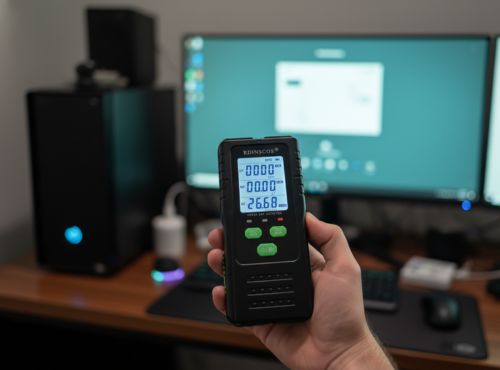
If you’re thinking about buying your first EMF meter, you’ve probably noticed the price range is all over the place. You can find meters on Amazon for $30 and others that run well over $300. That naturally raises the question: are cheap EMF meters accurate enough to be worth buying?
The short answer is that budget meters can tell you whether EMF levels in a given spot are high or low in relative terms. They are not reliable for precise measurements, verifying that shielding products work, or comparing before and after readings with any confidence. Whether that matters depends entirely on what you’re trying to do.
What “Accurate” Actually Means for an EMF Meter
Accuracy in an EMF meter comes down to a few things. The first is calibration, which is whether the meter has been tested against a known reference to confirm its readings are correct. The second is frequency response, which is how well the meter detects signals across the full range of frequencies it claims to cover. The third is sensitivity, which is the smallest signal the meter can reliably pick up.
Most meters under $50 are not independently calibrated. They are assembled, loaded with firmware, and shipped. That does not mean every reading is wrong. It means you have no way to verify how far off the readings might be, and no guarantee that two units of the same model will give you the same number in the same spot.
Frequency response is where budget meters tend to fail in ways that actually matter. A meter might claim to measure RF up to 8 GHz on the box, but its sensitivity may drop off sharply above 3 or 4 GHz. That means it could under-read or completely miss your 5 GHz Wi-Fi band, which is the one most modern routers default to. You would see a low reading and assume everything is fine when the meter simply was not picking up the signal.
Where Budget Meters Are Useful
If all you want is a general sense of your environment, a cheap meter can do that. Walking around your home with a $35 meter and seeing the numbers spike near your breaker panel, your microwave, or your Wi-Fi router tells you something real. Those relative differences between high spots and low spots are generally reliable even on budget hardware.
A cheap meter is also fine for satisfying initial curiosity. If you are just starting to explore EMF and want to see whether there is anything interesting going on in your home before committing to a better tool, a budget meter gets you in the door. I would rather someone start with an inexpensive meter than never measure at all.
Where Budget Meters Let You Down
The problems show up when you need to trust the actual numbers.
If you buy an EMF shielding product and want to confirm it is working, you need a meter that gives consistent, repeatable readings. A budget meter might show you 0.4 mG one second and 1.2 mG the next in the same spot without anything changing. That kind of variance makes it impossible to tell whether your shielding made a difference or the meter is just wandering.
If you are trying to compare your readings to any published guidelines, like the Building Biology precautionary levels, the numbers need to mean something. A meter that under-reads RF by 40% in certain frequency bands will make your environment look safer than it actually is.
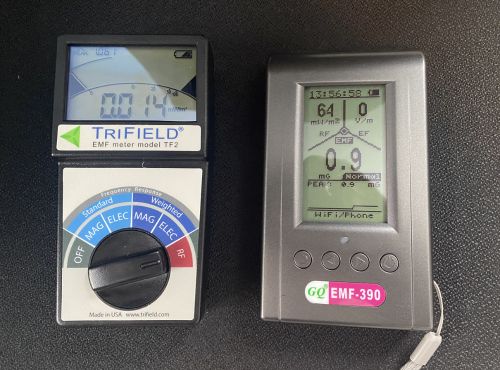
If you are measuring 5 GHz Wi-Fi specifically, most budget meters struggle here. The ERICKHILL ER02 is a good example. It is one of the more popular cheap meters on Amazon, and it technically covers the 5 GHz range. But its sensitivity at those frequencies is significantly lower than what you get from a meter like the Trifield TF2 or the GQ EMF-390. In practice, that means it can show you a quiet reading right next to a router that is actively transmitting on the 5 GHz band.
The Real Cost of a Budget Meter
Here is the thing that does not get talked about enough. A $30 meter that gives you unreliable readings can actually cost you more in the long run. You might decide a shielding product does not work when it does, or worse, decide your environment is fine when it is not. You might buy a second meter to check the first one. I have heard from readers who ended up buying three meters before landing on one they trusted, spending more total than if they had just started with a solid option.
I started with a Trifield TF2, which runs around $170. It is not cheap, but it covers magnetic fields, electric fields, and RF in one unit, and its readings have been consistent enough that I still use it as my baseline reference after years of testing. When I wanted more detailed RF data and the ability to log readings over time, I added the GQ EMF-390. Between the two, I can measure everything I need to in a normal home. If you want to see how these compare to other options across different price points, I put together a full breakdown in my guide to the top electromagnetic field detector.
Who Should Buy a Cheap Meter and Who Should Skip It
If you are brand new to EMF, mildly curious, and just want to wave a meter around your house to see what lights up, a budget meter will scratch that itch. Go in knowing the numbers are approximate and treat it as a learning tool, not a precision instrument.
If you are buying a meter because you want to measure your environment with any real confidence, verify that a product works, or make decisions based on the readings, skip the budget tier. The gap in reliability between a $35 meter and a $170 meter is not a small incremental improvement. It is the difference between data you can act on and numbers you are guessing about.
Start With the Right Tool for What You Actually Need
The best meter is the one that matches what you are trying to do. If curiosity is the goal, almost anything with a sensor will get you started. If you want readings you can trust and build on over time, invest in a meter that earns that trust from the first reading. You do not need the most expensive option on the market. You just need one that does what it says it does, consistently, across the frequencies that matter in your home.