If you’ve turned the Trifield TF2 dial and noticed there are two magnetic modes and two electric field modes, you’ve probably wondered what the difference is and which one to use. It’s one of the most common questions I hear from people who just got this meter, and the answer matters more than most guides let on.
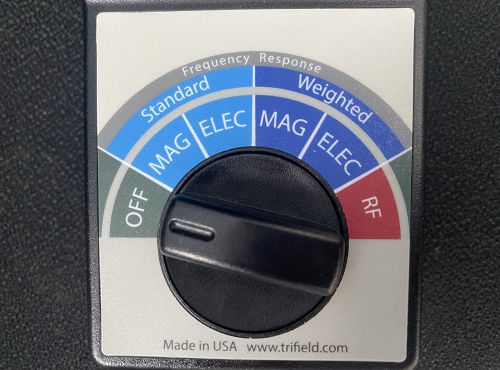
The short version is this: for home testing and comparing your readings to building biology benchmarks, always use standard mode. If you’re still deciding whether the TF2 is the right meter, the Trifield TF2 review covers what it does well and where its limits are before you commit.
But understanding why requires a quick look at what weighted mode is actually doing, and the readings I took on three different household sources make that difference concrete in a way that a technical explanation alone doesn’t.
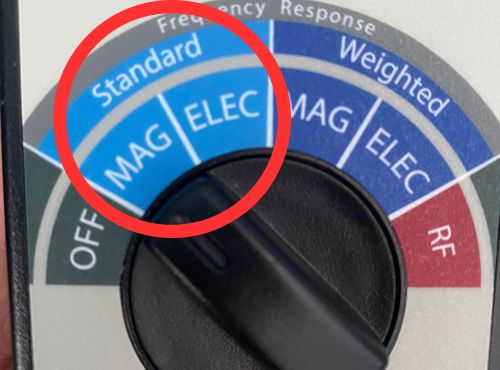
What Standard Mode Measures
Standard mode measures the actual magnetic or electric field strength as it is, flat across the frequency range the meter covers. What you see on the display is a direct representation of the field at that location. No filtering, no emphasis on any particular frequency.
When the Institute for Building Biology and Ecology developed their precautionary benchmarks for sleeping areas, those thresholds were based on standard unweighted measurements. If you measure in standard mode and compare your reading to those guidelines, you’re making a valid comparison. The number on your meter and the number in the guidelines are speaking the same language.
What Weighted Mode Measures
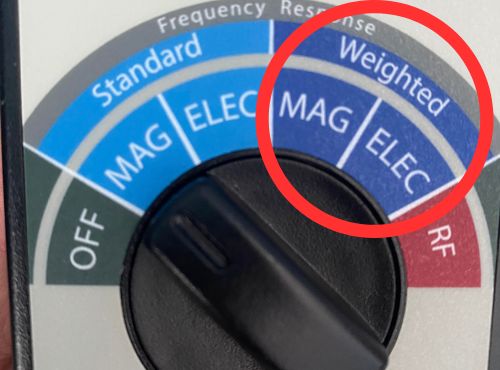
Weighted mode applies a frequency filter before displaying the reading. The filter is designed to emphasize the frequencies that were once thought to be most biologically significant based on older research into how different parts of the EMF spectrum interact with the human body.
In practice this means weighted mode gives more weight to certain frequencies and less to others. On some sources the weighted reading will be higher than standard. On others it can actually be lower. The result depends entirely on the frequency content of the source you’re measuring, not just its raw field strength.
This is where a lot of people get confused. They assume weighted mode always reads higher, or that a higher weighted reading means the source is more dangerous. Neither of those things is reliably true.
Three Sources, Three Different Stories
I tested standard and weighted mode on three household sources to show how differently the two modes can behave depending on what you’re measuring. In each case I held the meter in the same position and switched between modes without moving.
The stove (magnetic field)
In standard MAG mode I measured 17.9 mG with a peak of 18.5. Switching to weighted MAG, the reading went to 20.9 mG with a peak of 22.4.
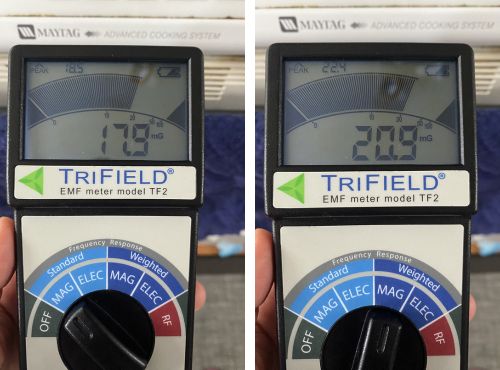
The stove runs on a straightforward 60 Hz electrical supply with relatively little harmonic content. The weighted reading is modestly higher than standard, about 17 percent in this case, which is the kind of difference you’d expect from a simple, clean electrical source.
The phone charger (magnetic field)
This is where the two modes diverge dramatically. In standard MAG mode the charger measured 0.5 mG with a peak of 0.3. In weighted MAG mode the same charger measured 2.4 mG with a peak of 2.3.
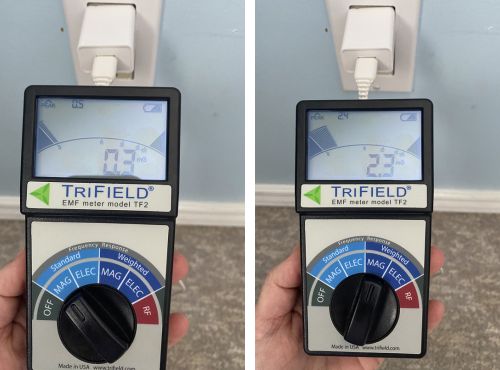
That’s nearly five times higher in weighted mode on the same source at the same distance. The reason is that phone chargers are switching power supplies. They don’t just produce a field at 60 Hz. They generate significant harmonic content at higher frequencies, and those higher frequencies are exactly what weighted mode is designed to amplify. The weighted reading isn’t wrong. It’s measuring something real. But it’s measuring something different from what the building biology benchmarks were calibrated against.
The power bar (electric field)
The electric field result was the most counterintuitive of the three. In standard ELEC mode the power bar measured 78 V/m with a peak of 73. In weighted ELEC mode it measured 62 V/m with a peak of 66.
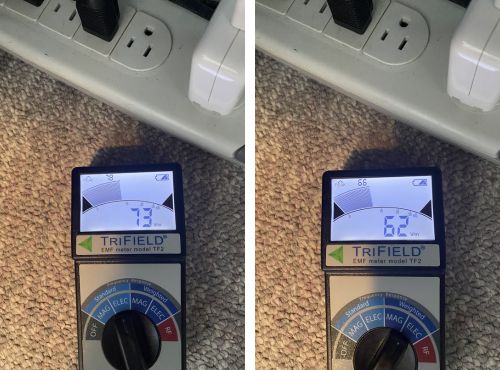
Weighted came in lower than standard. This is a good illustration of why the assumption that weighted always reads higher isn’t reliable. The frequency content of this particular source doesn’t align with the frequencies the weighted filter emphasizes, so the result goes the other way.
Why This Matters for Home Testing
These three examples together show why mode selection isn’t just a technicality.
If you measured your phone charger in weighted mode and got 2.4 mG, then compared that to the building biology benchmark of 1 mG for sleeping areas, you’d conclude you have a significant problem. If you measured the same charger in standard mode and got 0.5 mG, you’d conclude you’re well within the benchmark. Both readings came from the same meter on the same source at the same distance. The mode is doing the work, not the field.
The benchmarks were written for standard mode. Comparing weighted readings to standard benchmarks is like measuring a room in feet and comparing the number to a blueprint drawn in meters. The comparison doesn’t mean what you think it means.
This is also why it’s worth being cautious about readings you see shared online or in forum discussions without context. If someone posts a reading without specifying which mode they used, the number could mean very different things depending on the source.
So When Would You Use Weighted Mode?
Weighted mode was designed to give a reading that reflects the frequency-adjusted biological exposure rather than raw field strength. The idea is that a field with significant harmonic content might have different biological relevance than a pure 60 Hz field of the same measured strength.
In practice, weighted mode is most relevant in research or professional building biology contexts where the practitioner specifically wants to account for harmonic content and is comparing results to references that were developed using weighted measurements. For everyday home testing against standard precautionary guidelines, it adds complexity without adding useful information.
My honest take after testing both modes across many sources in my own home: I leave the dial on standard. If I want to understand why a reading is elevated, I focus on identifying and reducing the source rather than switching modes to see a different number on the same source.
The One-Line Answer
Use standard mode for home testing. Compare those readings to the building biology benchmarks. If you want to understand what weighted mode is actually doing under the hood and whether it ever changes what you should do about a reading, you now have a real-world picture of exactly that.
If you’re still getting familiar with the meter overall, the complete guide to how to use the Trifield TF2 walks through every mode and shows you how to take readings that are useful and comparable to the benchmarks that matter.