Choosing an EMF meter is more confusing than it needs to be.
There are dozens of models out there, ranging from $30 to $500+, all claiming to give you accurate readings. Some measure everything. Others only work for specific types of EMF. And the marketing language on most of them tells you very little about whether the thing will actually be useful in your home.
When I first started testing, I didn’t fully understand what I needed. I bought my first meter based on price and Amazon reviews, and it got me started, but it took a while before I understood which specs actually matter and which ones are just noise.

This guide is what I wish I’d had before I bought anything. I’ll walk you through the key decisions, explain what the specs mean in plain language, and help you figure out what kind of meter actually fits your situation. For specific product recommendations based on these criteria, EMF Protection Pros covers the recommended EMF meter to buy depending on what you’re measuring and your budget.
If you’d like to see how specific meters performed in real home testing, here’s our best EMF meters roundup.
Start Here: What Do You Actually Want to Measure?
This is the question most people skip, and it’s the most important one.
EMF is not one thing. It’s a broad term that covers several different types of fields, and different meters measure different things. If you buy the wrong type for what you’re trying to test, you’ll get either useless readings or nothing at all.
Here’s a quick breakdown of what’s out there.
Magnetic and electric fields come from the electrical wiring in your walls, appliances, power lines, and anything plugged into an outlet. These are sometimes called ELF fields, for extremely low frequency. If you want to test your electrical panel, your bedroom wiring, your refrigerator, or a lamp cord, this is what you need to measure.
Radio frequency (RF) comes from wireless devices. Your Wi-Fi router, your cell phone, Bluetooth speakers, smart meters, and cell towers all emit RF. This is a completely different type of field, and many basic meters don’t measure it at all.
Combo meters try to do both. They cover magnetic fields, electric fields, and RF in one device. The Trifield TF2, which is the meter I use most often, is a combo meter. So is the GQ EMF-390, which I use when I want to track readings over time or look at specific frequency ranges in more detail.

Figure out which category fits your concern and that alone will narrow the field significantly.
The Features That Actually Make a Difference
Once you know what type of meter you need, here’s what to pay attention to when comparing models.
Single-Axis vs. Tri-Axis
This one matters more than most people realize.
A single-axis meter has one sensor. It only picks up fields coming from one direction at a time, which means you have to slowly rotate the device to find the orientation that gives you the highest reading. It works, but it’s slow and easy to miss things.
A tri-axis meter has three sensors arranged at right angles to each other. It measures in all three directions at once and gives you the combined total automatically. No rotating required.
The price difference is usually somewhere in the $50 to $100 range. For anything beyond a one-time test, tri-axis is worth it. I use tri-axis meters for everything.
Frequency Range for RF Meters
If you’re shopping for an RF meter, the frequency range listed in the specs is one of the most important things to check.
Different wireless technologies operate at different frequencies. Standard Wi-Fi runs at 2.4 GHz and 5 GHz. Bluetooth is in a similar range. Many 5G signals push well above that, sometimes above 10 GHz depending on the band.
If your meter’s range tops out at 3 GHz, it won’t pick up anything above that. For most home testing, a range up to 8 GHz covers the majority of what you’ll encounter. If you’re specifically concerned about higher-frequency 5G bands, you’ll need something that goes further.
Always check the spec sheet, not just the marketing copy.
Display and Usability
You’re going to be walking around your home, checking readings in corners, closets, and places without great lighting. A meter with a small, dim, hard-to-read display gets frustrating quickly.
Look for a backlit digital display with numbers large enough to read at arm’s length. Some meters also include a bar graph or a color-coded LED strip (green, yellow, red) that gives you a fast visual read without having to focus on exact numbers. I find that genuinely useful when I’m scanning a room quickly.
Audio feedback is another thing I didn’t think I’d care about until I used it. A meter that beeps faster as readings increase lets you walk slowly through a room while looking at the space rather than the screen. It’s a small thing that makes testing a lot more practical.
Accuracy
Consumer meters typically have an accuracy margin of around 3 to 10 percent. For home use, that’s fine. You’re looking for relative differences between locations and sources, not laboratory-grade precision.
The meters that get down into the 1 to 2 percent range are professional instruments that cost $500 or more. Unless you’re doing this professionally or have a very specific technical need, that level of precision isn’t necessary.
Consistent, repeatable readings matter more than chasing perfect accuracy.
Build Quality and Battery Life
A meter that feels flimsy usually is. Read reviews that mention long-term durability, not just first impressions. Check whether a protective case is included or available.
Battery life varies a lot across models. Some meters run for 40 or 50 hours on a single set of batteries. Others die after 10. If you’re doing a thorough room-by-room test of your home, a short battery life becomes genuinely inconvenient. Check the spec before you buy.
Understanding the Different Types of Meters
Here’s a more detailed breakdown of the main categories.
ELF Meters
These measure low-frequency magnetic and electric fields from household wiring and appliances. Readings are displayed in milligauss (mG) or microtesla (µT), which are just two different units for the same thing. In the US, mG is the more common unit.
ELF meters are what you’d use to test your electrical panel, check the fields around your refrigerator, measure an electric blanket, or investigate wiring in a bedroom wall. They’re usually the most affordable type, with solid options available in the $50 to $100 range.
One thing to know: ELF meters do not measure RF from Wi-Fi or cell phones. If that’s what you’re after, you need an RF meter or a combo.
RF Meters
These detect wireless signals from routers, phones, smart meters, cell towers, and other wireless sources. The key spec to check is frequency range, as I mentioned above.
A good RF-only meter like the Safe and Sound Pro II tends to have better sensitivity for wireless signals than a combo meter at the same price point. If RF is your primary concern and you already have something for ELF, a dedicated RF meter is worth considering. That’s actually how I use mine. The Trifield handles day-to-day testing and I reach for the GQ EMF-390 when I want more detailed RF data.

Combo Meters
Combo meters cover magnetic fields, electric fields, and RF in one device. They’re convenient and usually the right starting point for someone who wants to understand their home environment across all three types.
The tradeoff is that a combo meter at a given price point will generally be a bit less sensitive than a dedicated meter at the same price. For most home testing purposes, that difference is not significant. But if you’re specifically trying to detect weak RF from a distant cell tower, a dedicated RF meter will outperform a combo at the same price.
For beginners, I’d start with a quality combo meter. You can always add a specialized meter later if you identify a specific need.
Professional Meters
Building biologists and EMF consultants use meters that run $300 to $2,000 or more. They offer higher accuracy, wider frequency ranges, better sensitivity, and features like calibration options and detailed data logging.
For home testing, you don’t need this level of equipment. The meters in the $100 to $200 range will give you everything you need to understand your space and make informed decisions.
What You Probably Don’t Need
A few features show up in marketing copy that sound useful but rarely are in practice.
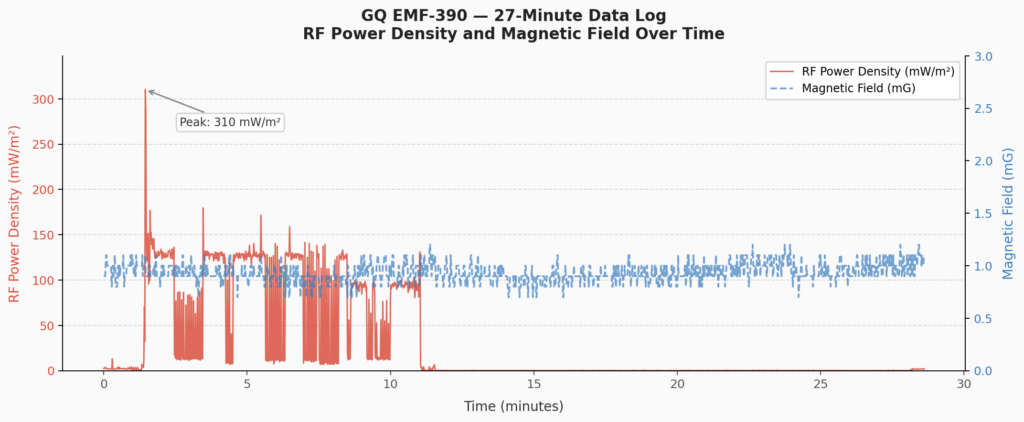
Data logging sounds helpful. In reality, most people test a spot once, note the reading, and move on. I use the data logging on my GQ EMF-390 for specific long-term observations, but it’s not something I use on every test session.
Multiple unit display modes let you switch between mG, µT, V/m, and so on. Useful to understand once. In practice, you’ll pick one unit and stick with it.
PC connectivity and graphing software exist on some meters. Again, useful for specific research purposes, but most home users will never set it up.
Don’t pay a premium for features that won’t fit into how you actually use the meter.
Price Ranges and What to Expect
Under $50: Basic single-axis meters with limited features. These can give you a rough sense of what’s happening but expect compromises in sensitivity, accuracy, and usability. Fine for casual curiosity, but not what I’d recommend if you’re planning to do a real home assessment.
$80 to $150: Where most people should start. You can find reliable tri-axis combo meters with good accuracy and usable displays in this range. The Trifield TF2 sits here and it’s what I point beginners toward.
$150 to $250: Quality combo meters and strong dedicated RF meters. Better sensitivity, wider frequency ranges, more durable builds. Worth spending here if you have a specific concern or want more detailed RF data.
$300 and above: Professional territory. Only worth it if you’re doing this work professionally or have a very specific technical requirement.
What to Watch for When Reading Reviews
Not all reviews give you useful information. Here’s what I pay attention to.
Look for reviews from people who used the meter over several weeks or months, not just out of the box. Long-term performance is what matters.
Look for use cases similar to yours. If you’re trying to measure Wi-Fi at 5 GHz, prioritize feedback from people who actually tested that.
Pay attention to patterns in the complaints. One person mentioning a dim display might just be their preference. Ten people saying the same thing is a design issue.
Be skeptical of generic five-star reviews that don’t say anything specific. They don’t tell you how the meter actually performs.
Common Mistakes Worth Avoiding
Buying on price alone tends to lead to a second purchase. A cheap meter that doesn’t measure what you need isn’t a bargain.
Skipping the frequency range specs on RF meters is probably the most common mistake I see. If the range doesn’t cover what you’re trying to test, it doesn’t matter what else the meter does.
Buying more features than you’ll actually use is also common. More buttons and modes don’t make a meter more accurate. Simple and reliable is usually the better call.
Not accounting for distance when interpreting readings is worth mentioning here too. A reading of 50 mG right next to your microwave during a 90-second heating cycle is very different from a reading of 5 mG in the spot where you sleep every night. Context matters as much as the number.
How to Make the Decision
Start by figuring out what you actually want to measure. That one decision narrows the field more than anything else.
Set a realistic budget. For most people, $100 to $200 gets you a meter that will do everything you need for home testing without unnecessary complexity.
Prioritize tri-axis detection, an appropriate frequency range for your sources, a readable backlit display, and solid construction. Those are the things that will matter every time you use it.
Read detailed reviews from people who used the meter for actual testing, not just unboxing.
Once you know what you’re looking for, the choice becomes a lot clearer. You don’t need to test everything or spend a lot to get useful information about your home. You just need the right tool for what you’re actually trying to understand.
I’m not a doctor or an engineer, and nothing on this site is medical advice. EMF research is still evolving, and I aim to share what the current evidence suggests rather than draw conclusions the science hasn’t reached yet.